
Catnip toys for indoor cats can be a surprisingly practical fix for boredom, but only when you pick the right type and use them in a way that keeps novelty alive. If you’ve got a cat who patrols the hallway at 2 a.m., stalks your ankles, or treats the couch like a scratching project, boredom is often part of the picture.
Indoor cats usually have fewer “jobs” than outdoor cats: fewer scents, less hunting, fewer decisions. That doesn’t mean they’re unhappy, it just means you may need to provide a bit more structure—short play bursts, environmental variety, and toys that encourage natural behaviors.
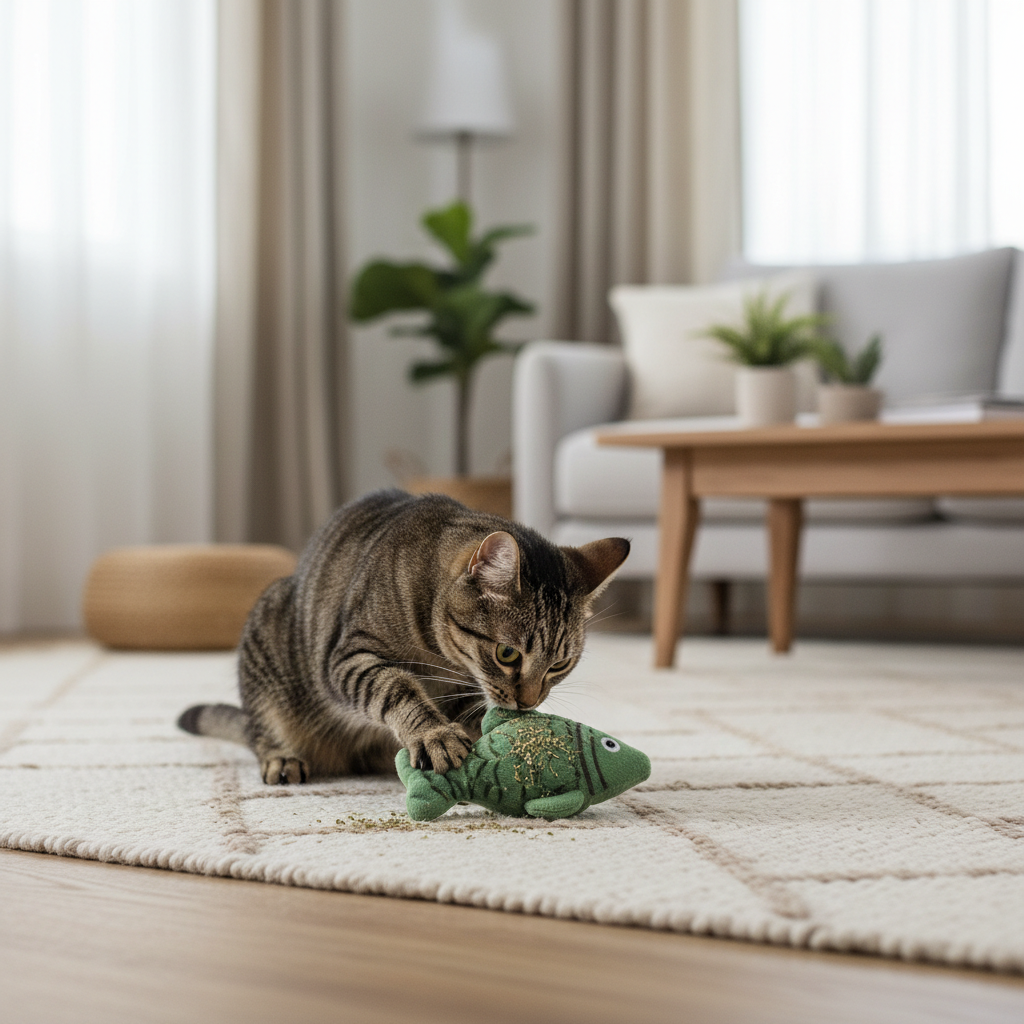
Quick heads-up: catnip doesn’t work the same for every cat, and some cats get overexcited. This guide helps you figure out whether catnip is the right tool, how to choose safer products, and how to use them to reduce boredom without turning your home into chaos.
Why indoor cats get bored (and what catnip can change)
Boredom in cats is rarely “my cat feels sad” in a human way, it’s more like unused energy plus too few outlets. Many behavior problems sit on top of that.
- No hunting sequence: stalking, chasing, grabbing, and “killing” prey is a built-in need for many cats.
- Same space, same smells: indoor environments can get predictable fast.
- Play patterns get stale: leaving the same toys out all week often makes them invisible.
- Solo time: if you work long hours, your cat may sleep all day and “party” at night.
Catnip can help because it changes how a toy feels to the cat—more interesting, more rewarding, sometimes more “alive.” But it’s not a replacement for interactive play, and it’s not a cure-all for stress-related behavior.
Does catnip work on all cats? A quick reality check
Some cats love catnip, some ignore it, and a few get a little too intense. Age also matters; kittens often show minimal response until they’re older.
According to the ASPCA, sensitivity to catnip is inherited, and not every cat responds to it. So if your cat sniffs and walks away, that can be totally normal.
- Common “yes” signs: rolling, cheek rubbing, bunny-kicking a toy, playful zoomies for a short window.
- Common “no” signs: a quick sniff, then disinterest, or choosing other toys instead.
- Too much signs: swatting harder than usual, dilated pupils with frantic behavior, guarding the toy.
If your cat tends to overstimulate easily, you can still use catnip toys, just with shorter sessions and more supervision.
Self-check: is boredom the problem—or something else?
Before you buy a pile of catnip toys for indoor cats, it helps to identify what you’re actually trying to solve. This quick checklist usually clarifies it.
Boredom is likely if you see:
- Nighttime running, sudden “attack the feet” moments, or attention-seeking meows
- Interest in play for 1–2 minutes, then quitting because the game isn’t engaging
- Getting into cabinets, knocking items down, or “inventing” trouble
Something else may be going on if you see:
- New aggression or hiding that appears suddenly
- Overgrooming, bald patches, or skin irritation
- Litter box changes (outside the box, straining, frequent trips)
- Yowling that seems pain-related
Those second-group signs can involve medical or anxiety issues, so it’s safer to talk with a veterinarian or a qualified behavior professional rather than assuming it’s “just boredom.”
Choosing the right catnip toy: types, materials, and what they’re good for
Not all catnip toys create the same kind of play. A toy that works for a kicker may be boring for a chaser. Here’s a practical breakdown.

| Catnip toy type | Best for | What to watch |
|---|---|---|
| Kick sticks / “kickers” | Wrestling, bunny-kicks, solo play | Seams should be strong; avoid loose ribbons |
| Small plush mice/balls | Batting, carrying, hiding | Skip plastic eyes if your cat chews aggressively |
| Refillable pouches | Keeping toys “fresh” over time | Look for secure closures to prevent spills |
| Catnip + crinkle toys | Cats that react to sound cues | Some cats get startled; introduce slowly |
| Catnip sprays (used on toys) | Rotation, scratching posts, tunnels | Let it dry; avoid spraying directly on your cat |
Material matters more than people think. If your cat is a serious chewer, choose sturdier fabric and minimize detachable parts. If your cat is gentle, lighter toys with softer textures might get more attention.
How to use catnip toys to actually reduce boredom (not just buy stuff)
The difference between “my cat loved it for five minutes” and “this helps week after week” is mostly how you run the routine.
1) Treat catnip like a limited-time event
- Offer catnip toys for 10–15 minutes, then put them away.
- Keep only 1–2 catnip items in rotation at a time.
Many cats habituate quickly. Putting toys away sounds boring to us, but it’s how you keep them “new.”
2) Pair catnip with a hunting-style play sequence
- Start with a wand toy for stalking and chasing.
- Then introduce a catnip kicker for the “catch and wrestle” part.
- End with a small meal or a few treats to complete the cycle.
According to the American Association of Feline Practitioners (AAFP), cats benefit from enrichment that supports natural behaviors like hunting and foraging. Catnip can be one piece of that, not the whole plan.
3) Use “placement” like it’s part of the toy
- Near a window perch for a calmer cat who likes watching outside
- Inside a tunnel for cats who ambush and hide
- On a rug or mat to reduce sliding frustration on hard floors
Practical weekly rotation plan (simple, realistic)
If you’re busy, a complicated enrichment schedule won’t stick. This low-effort rotation works for many homes, and you can adjust based on your cat’s response.
- Mon/Wed/Fri: 10 minutes wand play, then 10 minutes with one catnip toy, put it away.
- Tue/Thu: non-catnip solo toy day (ball track, puzzle feeder, or paper bag play with supervision).
- Weekend: “reset day” where you swap toys, refresh a refillable pouch, or use catnip spray on a scratcher.
If you share your home with multiple cats, consider separate play stations. Resource guarding can look like “my cat is obsessed with catnip,” but it’s sometimes a social stress signal.
Safety notes and common mistakes (this is where people get burned)
Catnip is generally considered low-risk for most cats, but the toy design and the context matter.
- Don’t leave fragile toys out unsupervised if your cat rips fabric or eats strings.
- Avoid essential oils as a DIY substitute; concentrated oils may be irritating or unsafe. If you’re unsure, ask your veterinarian.
- Don’t “stack” stimulation: catnip plus laser plus loud play can push some cats into overarousal.
- Watch the stomach: some cats nibble catnip toys; if vomiting or diarrhea appears, pause use and consult a professional.
One more common mistake: using catnip to “fix” scratching without offering a better scratching option. Catnip can attract a cat to a scratcher, but the scratcher still needs the right height, stability, and location.
When to get professional help (and what to bring to that conversation)
If boredom looks like mild mischief, enrichment usually helps. If you’re seeing big behavior shifts, it’s smarter to involve a vet or a qualified behaviorist.
- Sudden aggression, especially if it’s new in an adult cat
- Behavior changes paired with appetite or litter box changes
- Compulsive behaviors like persistent overgrooming
- Household conflict between cats that escalates around toys
Bring details: what toys you used, how long play sessions lasted, what time of day behavior spikes, and whether catnip seemed to calm or rev up your cat. That kind of specificity helps professionals rule things in or out.
Conclusion: make catnip part of a system, not a one-time purchase
Catnip toys for indoor cats work best when they’re used with intention—short sessions, real rotation, and a play pattern that lets your cat stalk, catch, and settle. If you do that, you usually see less “bored trouble,” and more relaxed downtime.
If you want one action to take today, pick one durable catnip toy and commit to a three-day routine: play, offer the toy briefly, then put it away. Small consistency beats a big shopping haul.
FAQ
How often should I give my cat catnip toys?
Many cats do better with occasional access rather than all-day availability. A few short sessions per week keeps the novelty, and it’s easier to notice if your cat gets overstimulated.
My cat ignores catnip—does that mean the toy is bad?
Not necessarily. Some cats simply don’t respond to catnip, and others respond only to certain forms (spray vs dried). Try a different toy texture or a refillable pouch before writing it off.
Can catnip toys help with nighttime zoomies?
They can, especially when used after an interactive play session and followed by a small meal. The goal is to shift energy earlier in the evening, not just hype your cat up at bedtime.
Are catnip sprays as effective as dried catnip inside toys?
Sprays are convenient for refreshing scratchers and tunnels, but effects vary by product and cat. Let the sprayed area dry, and use it as a “bonus,” not the only enrichment tool.
Is catnip safe for kittens?
Many kittens show little reaction until they’re older. If you try it, use a small amount and monitor behavior, and if you notice stomach upset or frantic overarousal, pause and ask your veterinarian.
What’s the best catnip toy for a cat that bites and shreds plush toys?
Look for sturdier kickers with reinforced seams and minimal attachments. If your cat tends to ingest fabric, supervised use is the safer route, and you may need to prioritize harder-wearing interactive toys instead.
Can I use catnip toys to train my cat to use a scratching post?
Often, yes—catnip can draw attention to the post. Placement and stability still matter more than scent, so put the post where your cat already scratches and make sure it doesn’t wobble.
If you’re trying to reduce indoor-cat boredom and you’d rather not guess, a simple approach is to pick a small rotation of toys—one catnip option, one interactive wand, and one solo enrichment item—then adjust based on what your cat actually repeats, not what looks cute in the cart.